TL;DR
- Decide whether you need a discovery interview or an impression test before planning anything
- Screen participants before recruiting: who you talk to determines what you learn
- One interviewer on camera, all other stakeholders off camera and silent
- Ask open questions, let silence do work, and follow thin answers before moving on
- Synthesis turns raw notes into insight statements: name the pattern, explain why it exists, state the consequence
Most designers walk into a user interview with a hypothesis. They leave with confirmation. That is not research. That is an expensive way to hear what you already believe.
Good interviews create conditions for users to surprise you. Here is how to run them.
Two types of interviews
Before you plan anything, decide which type of interview you need.
Discovery interviews are hypothesis-driven. You have a question about your target audience: their mental models, priorities, pain points. You want real signal before you design anything. The goal is to understand how users think, not validate a solution.
Impression tests are concept-driven. You have a direction and want to know how it lands. You show users a screen or prototype and watch their natural reaction. The goal is honest response, not approval.
The facilitation looks different, but the discipline required is the same.
Before the interview
Screen your participants
Do not skip the screener. A short survey before recruiting confirms participants match your target audience and are willing to engage. Who you talk to determines what you learn.
Offer an incentive
Incentives increase participation and signal that you respect people's time. Gift cards work. So does a charitable donation in their name. The amount matters less than the gesture.
Build an interview guide
Write your objectives before you write a single question. What do you need to understand by the end of this session? Your objectives are your compass. When a conversation runs long or a thread runs dry, you know exactly what to protect.
Your guide is not a script. It is a map. Know your destination well enough to navigate detours without losing time.
Opening the session
How you start determines what you get.
Cover four things before your first question:
- Permission to record. Explain how the recording will be used and who will see it.
- Agenda. Give participants a sense of what the session covers and how long it runs.
- No wrong answers. Say this out loud. Users often try to give the "right" answer. Your job is to remove that instinct before it shapes the data.
- Open invitation. Let them know you want honest reactions, not polished thoughts.
One interviewer. One camera.
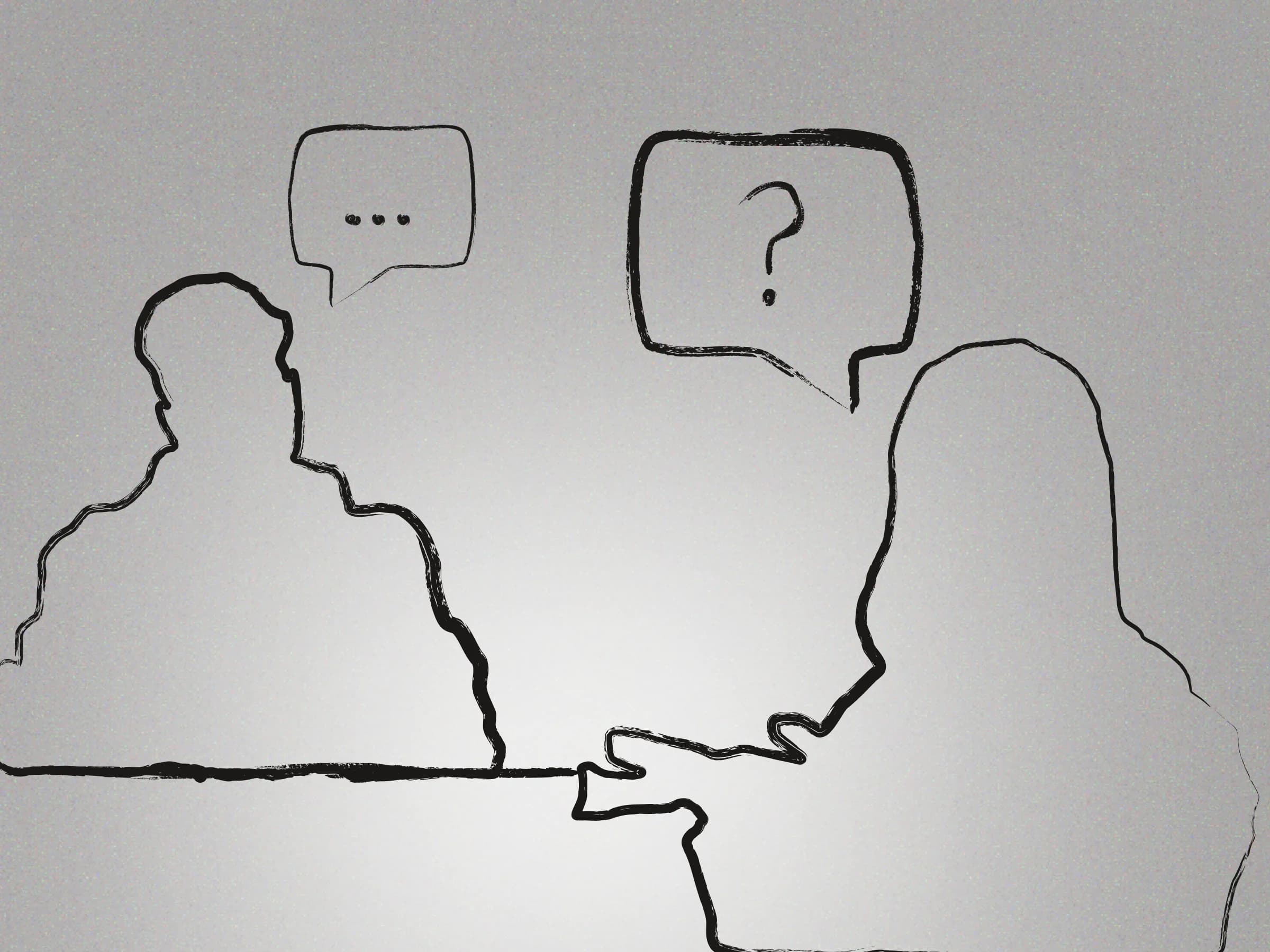
This is not optional. One interviewer on camera. All other stakeholders join off camera, anonymized, and silent.
Think of it like a blood sample. The moment a second voice enters the session, you contaminate the data. A participant who senses an audience adjusts what they say. A stakeholder who asks a question, however well-intentioned, signals a direction.
If stakeholders have questions, give them a channel to pass them to you before the session or during a break. You work them in naturally. They never interrupt.
During the interview
Ask open questions
Every question should invite a story, not a yes or no. "How do you currently handle that?" surfaces a process. "Do you find that frustrating?" shuts one down.
If you catch yourself asking a closed question, follow it immediately with "tell me more about that."
Do not interrupt
Let silence do work. When a user pauses, wait. The instinct is to fill the gap. Resist it. The most honest answers often come after a beat of quiet, not before.
Know when to dig deeper
When a user gives you something thin, follow it:
- "Tell me more about that."
- "Can you walk me through what that looked like?"
- "What did you do next?"
Your guide tells you when you have enough on a given objective. Move on when it is covered. If something unexpected surfaces, the buffer in your agenda is there for exactly that.
Impression tests: do not over-explain
When showing a concept, state the name or purpose of the screen in one sentence and stop. Do not walk users through what you intended. Everyone's mind works differently. You are there to see what lands, not to defend what you built.
Open with: "What are your first impressions?" or "How is this landing for you?" Then listen.
Closing the session
Before you end, open the floor.
Ask: "What else is on your mind?" or "What did we not get to that you wanted to share?"
Users often hold back their most candid observations until the session feels like it is wrapping up. This space reaches things no planned question would have.
Synthesizing discovery interviews
Running the sessions is only half the work. Raw notes do not give you answers on their own. You have to process them.
Start by tagging every note. Most interview guides produce four types: pain points, opportunities, observations, and general notes. Tag each quote or observation as you go.
Then group answers by question. For each question in your guide, pull every response from every participant into one view. Look for clusters: answers that point to the same underlying pattern. Take one or two passes until you cannot condense any further.
When the clusters hold, write an insight statement for each one. An insight statement is not a summary. It names the pattern, explains why it exists, and states the consequence:
First-time managers struggle to give useful feedback because they lack a shared framework, which leads to inconsistent reviews and lower team trust.
That is specific, causal, and actionable. A restatement of what users said is not an insight. It is a transcript.
Synthesizing impression tests
Impression test synthesis follows the same grouping process, but the output is a prioritized action list rather than insight statements.
Once reactions are clustered, evaluate each finding against two dimensions: impact on the user experience and effort to design or implement. A simple table works: the finding, a short description or user story, an impact score, an effort score.
Then review the table with your team or client. Answer questions, resolve disagreements, and confirm what changes. The goal is shared agreement, not a unilateral call.
High impact, low effort items move first. Everything else gets sequenced or cut.
Final thoughts
User interviews are not conversations. They are structured listening sessions. Your job is to create conditions where people feel comfortable saying what they actually think, then stay out of the way.
Ask open questions. Do not interrupt. Dig deeper when answers are thin. Keep stakeholders off camera. Leave space at the end. Then do the synthesis work that turns raw responses into something your team can act on.
Treat interviews as a discipline and they will stop confirming what you already think.
Get articles like this in your inbox
No spam. Unsubscribe any time.